In short
AMD FSR as the game itself ships it.
Use OptiScaler to reach an FSR output a game did not ship, or to test FSR4 paths; native FSR needs no layer when it is already current.
How to decide
Confirm the game exposes a supported temporal input and which API it runs.
Test both options in the same scene with the same resolution.
Judge frame time, UI cleanliness and latency — then keep the winner and remove the other cleanly.
OptiScaler vs native FSR (2026-10-18)
| Topic | OptiScaler | native FSR |
|---|---|---|
| What it is | Redirects a supported input to FSR — including newer FSR outputs where supported | The FSR version bundled with the game |
| Why redirect | Game ships DLSS only, an old FSR, or no output your GPU prefers | Game's FSR is already the version you want |
| FSR4 | Possible output path; GPU/driver/game permitting, fallback possible | Only if the game ships it |
Frequently asked questions
What is OptiScaler?
OptiScaler is a community tool that can intercept supported in-game upscaler calls and redirect them to another supported upscaling backend, with additional tuning options.
How does OptiScaler work in a game?
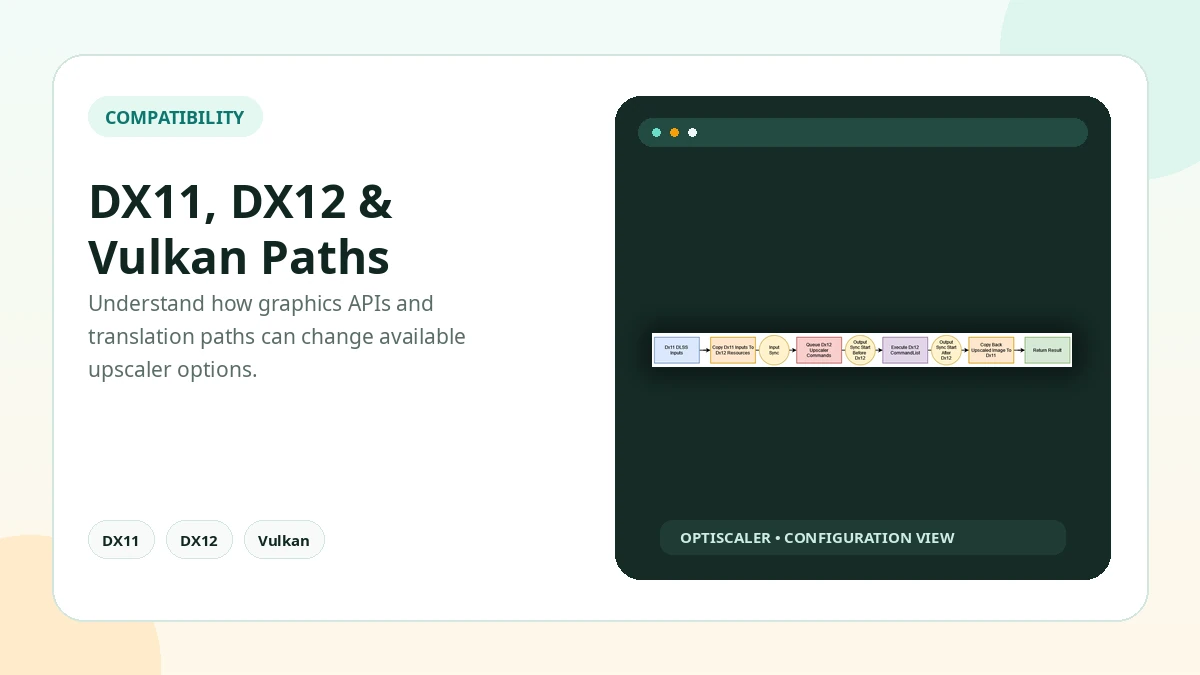
The game exposes an input upscaler, OptiScaler sits between the game and the selected output backend, and the chosen output handles the final upscaling path where compatibility allows.
Does OptiScaler support DirectX 11?
Yes, DirectX 11 is supported, although the available output methods and behavior can differ from DirectX 12.
Facts that do not change
- Version: OptiScaler 0.9.4 (reference build, July 2026)
- APIs: DirectX 11, DirectX 12, Vulkan
- Upscalers: DLSS, FSR and XeSS inputs/outputs where compatible
- Frame generation: Experimental OptiFG (DirectX 12)
- Overlay: Insert key
- Install: ZIP extracted next to the main game executable
- Platform: Windows; Linux via Proton/Wine varies
- Site: Independent guide — not the official project site
Practical Checklist
- Keep original files backed up before changing the game folder.
- Test one setting or backend at a time.
- Avoid anti-cheat protected online sessions.
- Document the working configuration before updating.
Related Guides
Continue with the related guides in the sidebar for setup, compatibility, performance, or safety topics.
- OptiScaler vs Lossless Scaling, DLSS, FSR and XeSS — Side-by-side notes for OptiScaler versus Lossless Scaling, native DLSS, native FSR and native XeSS.
- OptiScaler guides: install, FSR4, Linux, performance and safety — Step-by-step OptiScaler guides for installation, compatibility, performance, Linux, FSR4 and common user questions.
- OptiScaler vs Lossless Scaling — A paid Steam app that scales and frame-generates almost any window from outside the game. Pick OptiScaler when a game exposes a supported temporal input and you want the real upscaler pipeline; pick Lossless Scaling for games with no usable input or when you cannot place files by the executable.
- OptiScaler vs native DLSS — NVIDIA's DLSS as the game itself ships it, with no translation layer. OptiScaler does not replace DLSS as a technology; it redirects DLSS (and FSR/XeSS) calls. Keep native DLSS when it already does what you want.
- OptiScaler vs native XeSS — Intel XeSS as the game itself ships it. OptiScaler's value is choice: the same game input can be tested against XeSS and FSR outputs without waiting for a game patch.