What this hub is
Standalone URLs for the official site's 20 OptiScaler questions — APIs, overlay, FSR4, Linux, anti-cheat and the manager question.
OptiScaler 0.9.4 is a community translation layer for DirectX 11, DirectX 12 and Vulkan games. This host is an independent guide, not the official project site. Start from Download, then come back here for the per-game checks.
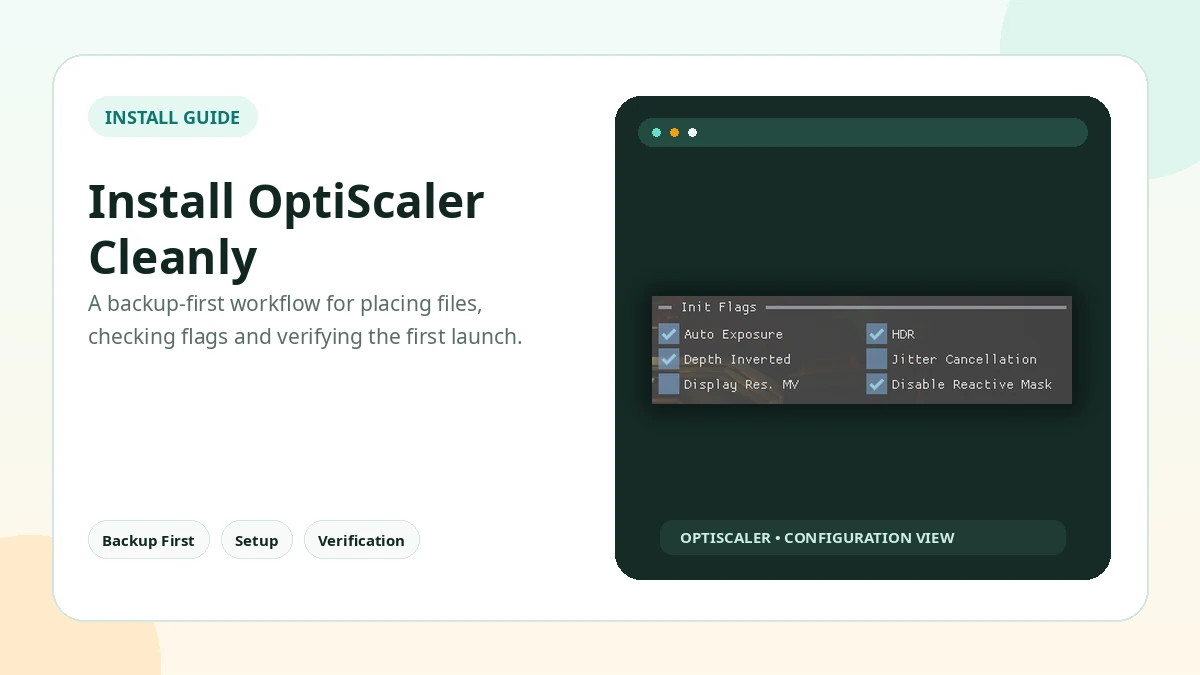
The safe order
- Back up the game folder.
- Extract the ZIP next to the main game executable.
- Launch offline and press Insert.
- Change one output at a time, and never test in online or anti-cheat protected games.
Pages in OptiScaler FAQ
- What is OptiScaler? — OptiScaler is a community tool that can intercept supported in-game upscaler calls and redirect them to another supported upscaling backend, with additional tuning options.
- How does OptiScaler work in a game? — The game exposes an input upscaler, OptiScaler sits between the game and the selected output backend, and the chosen output handles the final upscaling path where compatibility allows.
- Does OptiScaler support DirectX 11? — Yes, DirectX 11 is supported, although the available output methods and behavior can differ from DirectX 12.
- Does OptiScaler support DirectX 12? — Yes. DirectX 12 has broad support and is also the API used by experimental OptiFG functionality.
- Does OptiScaler support Vulkan? — Yes, Vulkan support exists, but individual upscalers and games can require specific compatibility conditions.
- Can OptiScaler replace DLSS with FSR or XeSS? — In compatible games, it can redirect supported DLSS-style inputs to another supported output such as FSR or XeSS.
- Can OptiScaler replace FSR inputs? — Many FSR input paths can work, but game-specific implementations vary, especially with older or custom FSR integrations.
- Does OptiScaler include frame generation options? — It can manage supported frame generation paths, and experimental OptiFG can add frame generation in some DirectX 12 scenarios.
- What key opens the OptiScaler overlay? — Insert is commonly used to open the overlay. Some keyboard layouts may need an alternate combination depending on the game and configuration.
- Is OptiScaler Manager an official separate app? — Be cautious with manager-style tools. Verify software sources carefully and do not assume a third-party manager or client is part of the core OptiScaler project.
- How do I install OptiScaler? — Extract the required files beside the main game executable and follow the setup method suitable for that game. Always back up replaced files first.
- Should I use OptiScaler in online games? — Avoid using it in online or anti-cheat protected games because injected or replaced files can be flagged and may create account risk.
- Why does the OptiScaler overlay not appear? — Common causes include an incorrect install folder, the wrong proxy DLL, input-hook conflicts, overlays, or a game-specific compatibility issue.
- Why does a game crash after installation? — Remove the added files to confirm the cause, then check the correct game executable folder, proxy selection, API support, and known compatibility limitations.
- Can I use OptiScaler on Linux? — Linux use is possible in supported configurations, commonly through Proton or Wine, but Vulkan, driver, and upscaler requirements can differ from Windows.
- What is OptiScaler FSR4 support? — FSR4 support depends on the selected output path, GPU capability, driver or SDK behavior, and game compatibility. Unsupported hardware may fall back to another path.
Frequently asked questions
What is OptiScaler?
OptiScaler is a community tool that can intercept supported in-game upscaler calls and redirect them to another supported upscaling backend, with additional tuning options.
How does OptiScaler work in a game?
The game exposes an input upscaler, OptiScaler sits between the game and the selected output backend, and the chosen output handles the final upscaling path where compatibility allows.
Does OptiScaler support DirectX 11?
Yes, DirectX 11 is supported, although the available output methods and behavior can differ from DirectX 12.
Does OptiScaler support DirectX 12?
Yes. DirectX 12 has broad support and is also the API used by experimental OptiFG functionality.
Facts that do not change
- Version: OptiScaler 0.9.4 (reference build, July 2026)
- APIs: DirectX 11, DirectX 12, Vulkan
- Upscalers: DLSS, FSR and XeSS inputs/outputs where compatible
- Frame generation: Experimental OptiFG (DirectX 12)
- Overlay: Insert key
- Install: ZIP extracted next to the main game executable
- Platform: Windows; Linux via Proton/Wine varies
- Site: Independent guide — not the official project site
Practical Checklist
- Keep original files backed up before changing the game folder.
- Test one setting or backend at a time.
- Avoid anti-cheat protected online sessions.
- Document the working configuration before updating.
Related Guides
Continue with the related guides in the sidebar for setup, compatibility, performance, or safety topics.
- OptiScaler guides: install, FSR4, Linux, performance and safety — Step-by-step OptiScaler guides for installation, compatibility, performance, Linux, FSR4 and common user questions.
- What is OptiScaler? — OptiScaler is a community tool that can intercept supported in-game upscaler calls and redirect them to another supported upscaling backend, with additional tuning options.
- How does OptiScaler work in a game? — The game exposes an input upscaler, OptiScaler sits between the game and the selected output backend, and the chosen output handles the final upscaling path where compatibility allows.
- Does OptiScaler support DirectX 11? — Yes, DirectX 11 is supported, although the available output methods and behavior can differ from DirectX 12.
- Does OptiScaler support DirectX 12? — Yes. DirectX 12 has broad support and is also the API used by experimental OptiFG functionality.
- Does OptiScaler support Vulkan? — Yes, Vulkan support exists, but individual upscalers and games can require specific compatibility conditions.